

Variety Release Policy
Revised: August 25, 2025
Downloadable pdf
Montana Agricultural Experiment Station (MAES) experimental lines are considered for release when the following conditions are met:
TESTING
- The minimum number of testing locations and calendar years required for release are:
- Cereal grains and pulses not intended for forage use require a minimum of 16 location-years collected in two cropping seasons for agronomic performance.
- Perennial and annual forage crops require data from at least 12 location years, not including the year of seeding, with at least one location providing an estimate of winter hardiness and/or drought tolerance.
- Horticulture and specialty crops require a minimum of one location and three cropping seasons.
- Native plants require AOSCA standards for sourceidentified or selected classgermplasm.
- Test results are adequate to determine the experimental lines' potential and limitations. It is recommended that at least four location years of pest evaluation data is available to properly assess pest susceptibility
APPLICATION FOR RELEASE
- Applications should include the following information:
- Pedigree and selection history.
- Agronomic and pest (e.g. disease resistance) data across minimum location years for the specific crop being proposed for release. Varieties relevant to growers that are currently grown must be included.
- Quality data.
- How the new variety differs from currently grown varieties.
- Variety description and number of increase generations permitted for seed certification program.
- Status of Breeder and Foundation Seed Inventory.
- Small Grains start with 20 bushels of Breeder seed.
- Pulses start with 100 bushels of Breeder seed.
- Breeders submit released varieties to AOSCA andPVP office within 12 months for registration.
- Breeders bring forward possible names at release meeting and ensure those names are available by contacting the USDA Agricultural Marketing Service in advance of the variety release meeting.
- Variety release applications must be submitted in writing and electronically to the Department Head of Plant Sciences and Plant Pathology (PSPP).
VARIETY RELEASE COMMITTEES
- The purpose of the Variety Release Committees is to decide whether a proposed variety is suitable for release and make a recommendation to the Director of MAES.
- Variety Release Committees include:
- Wheat
- Barley
- Pulses
- Forage Crop (other than wheat, barley, or pulses)
- Specialty Crop
- Horticulture and Native PLants
- The Variety Release Committees will consist of:
Variety Release Committees:Wheat, Barley, Pulse, Forage Crop, Specialty Crop, Horticulture & Native Plants
Members
Affiliation
Appointing Administrator
Chair (non-voting) PSPP Department Head Director of MAES Voting Members (16) TBD annually Breeder PSPP Department Head TBD annually Quality, Cereal or Forage PSPP Department Head TBD annually Plant Pathologist PSPP Department Head TBD annually Representative MT Foundation Seed Program TBD annually Representative MT Seed Growers Association TBD annually Weed Scientist LRES Department Head TBD annually Cropping Systems LRES Department Head TBD annually Entomologist LRES Department Head TBD annually NARC Staff Research Center Department Head TBD annually CARC Staff Research Center Department Head TBD annually WTARC Staff Research Center Department Head TBD annually NWARC Staff Research Center Department Head TBD annually EARC Staff Research Center Department Head TBD annually SARC Staff Research Center Department Head TBD annually Representative MAES State Advisory Council MSU Foundation Seed Program Manager MSU Foundation Seed PSPP Department Head One member from below added to each of the Five Variety Release Committees: Wheat Representative MT Wheat & Barley Committee Barley - Feed Representative MT Wheat & Barley Committee Barley - Malt Representative American Malting Barley Association Pulse Representative MT Pulse Crop Committee Specialty Crop Representative Research Center Head Hort-Native Plant NRCS Scientist Bridger Plant Materials Center Manager Other Forage Crop NRCS Scientist Bridger Plant Materials Center Manager Ex-officio Representative V.P. for Research and Economic Development - Chair will serve as a non-voting member for all Variety release committees and will assign a secretary.
- Committee recommendations shall be based on a majority rules basis. Written dissenting or concurring minority reports may be submitted.
- Committee members, if not present, must submit a written vote and a brief justification for their vote to the Chair. Each member has one vote. There is no voting by proxy.
- Committee members are required to case a vote and will not be allowed to abstain.
- Non-voting members are encouraged to attend meetings and participate in the discussions.
VARIETY RELEASE PROCEDURE
- Variety RElease Committees will usually meet in early February to allow adequate time for breeding and Foundation Seed programs to implement decisions.
- Char will solicit applications, assign membership, and forward applications to appropriate committee members.
- The breeder of the experimental line will present data and discuss its attributes, limitations, and recommended release option (E8a, b or c).
- Variety RElease Committee will consider whether the experimental line is equal or superior in overall merit to the check varieties or has unique characteristics or special-use considerations.
- Char will submit the Committee recommendations for approval the the Director of MAES.
- Administrative action taken will be transmitted to the Chari within 30 days from the Director of MAES. Chair will in turn notify Committee members about the administrative review result.
- Variety Release Committees may waive the requirements of a specific rule(s) above based on the recommendation of three-fourths (75%) of the Committee voting membership.
- The Director of MAES has veto power over Committee action. The Director of MAES will make the final decision on whether a variety passes Variety Release or not. Written approval by the Director of MAES is necessary for variety release.
VARIETY PROTECTION AND LICENSING COMMITTEE
- The Director of MAES will charge a Protection and License Release Committee with providing a recommendation on the release process.
- Variety Protection and Licensing Committees include:
- Wheat
- Barley
- Pulses
- Forage Crop (other than wheat, barley, or pulses)
- Specialty Crop
- Horticulture and Native Plants
-
The Variety Protection and Licensing Committees will consist of:
Protection and License Release Committee
Member
Affiliation
Appointing Administrator
Chair (non-voting) PSPP Department Head Director of MAES Voting Members (5) Representative MAES State Advisory Council Wheat or Barley OR Board Member Montana Wheat & Barley Committee Pulse OR
Board Member Montana Pulse Crop Committee Other Representative PSPP Department Head Representative Montana Seed Trade Association Representative PSPP Department Head Ex-officio Representative Montana Department of Agriculture, Seed Division Representative V.P. for Research & Economic Development - Chair will serve as a non-voting member for all variety release committees and will assign a secretary.
- Committee recommendations shall be based on a majority rules basis. Written dissenting or concurring minority reports my be submitted.
- Committee members, if not present, must submit a written voe or request a proxy to the Chair.
- Non-voting members are encouraged to attend meetings and participate in the discussions.
- Variety Release Options:
- Protected MSU Public Release: New release is protected with PVP under Title V., and with an MSU Research Fee on Registered and Certified Seed sold.
- License Release: New release is protected with PVP underTitle V. Variety is licensed under and exclusive (one business) or non-exclusive (more than one business) licenses by the MSU Technology Transfer Office (TTO). MSU royalty fees are collected under license releases and MAES Research Fees are not collected.
VARIETY PROTECTION AND LICENSING PROCEDURE
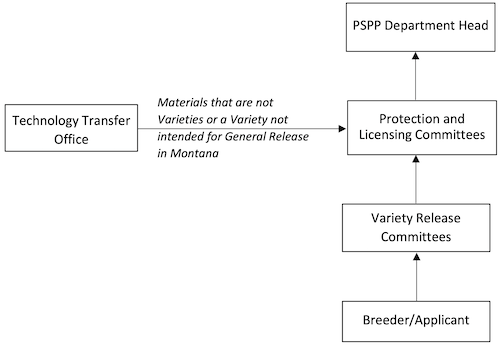
- There are two routes for matters to be submitted to the Protection and Licensing Committee
for consideration.
- If approved for release by the Variety Release Committee, the breeder shall submit an application to the Chair of the Variety Protection and Licensing Committee, with a recommended release option.
- Alternatively, the MSU TTO may request the Protection and Licensing Committee to consider
License Release of an MSU variety outside the state of Montana without first gaining
approval of the Variety Release Committee. Similarly,TTO may request approval to License
Release other licensable material. Other licensable materials include MSUgermplasm,
experimental plant lines, and plant varieties which meet any of the following criteria:
- Variety is not superior in overall merit to the check varieties currently available in Montana.
- The licensable material was previously released as a Protected Public Release.
- The licensable material is no longer under active development at MSU.
- The licensable material was developed under a Sponsored Research Agreement or other such agreement that grants a license option to the sponsor.
The criteria of TESTING and the procedure for APPLICATION FOR RELEASE are not required of other licensable materials; however, MSU TTOshall place requirements on licenses sufficient to reasonably ensure the delivery of a quality licensed product to the market.
- The Chair will assign membership and forward applications to appropriate committee members.
- The Committee may conduct business in person or via teleconference or e-mail.
- Committee members, if not present, must submit a written vote or request as a proxy to the Chair.
- The Chair will serve as a non-voting member and will assign a secretary.
- The breeder of the experimental line or MSU TTO will present data and discuss itsattributes, limitations, and eligibility for a license release.
- Committee recommendations shall be based on a majority rule basis. Written dissenting or concurring minority reports may be submitted.
- Char will submit the Committee recommendations for approval to the Director or MAES.
- Committees may waive the requirements of a specific rule(s) above based on the recommendation of three-fourths (75%) of the Committee voting membership.
- The Director of MAES has veto power of Committee action. The Director of MAES will make the final decision on Variety Release options (ES a, b, or c).
- Administrative action taken will be transmitted to the Chair within 30 days from the Director of MAES. Chair will in turn notify committee members about the administrative review result.
PUBLIC RELEASE VARIETIES (options E.8.a. and E.8.b.)
- A Research Fee will be collected on all Registered Class and Certified Class seed
sold of Protected Public Release varieties (option E.8.b.). The purpose of the fee
is to provide direct support to the MSU breeding and other MSU plant improvement programs.
The PSPP Department Head and the MAES Director will oversee an MSU designated fund
for protection of Plant Variety Protection (PVP) title V varieties. This will be distributed
as follows by thePSPP Department Head:
- pay for costs associated with PVP title V and fees (administrative and MAES)
- 50% of net to breeding program that developed the variety generating the research fees
- 50% of net to fund high priority programs for variety improvement, cereal quality, and focused outreach.
- A Research Fee Agreement developed by MAES between the company/private entity and MSU will be executed prior to distributing Foundation Seed of a Protected Public Release (option E.8.b.) to the company/private entity.
- Montana Foundation Seed Program is responsible for the increase of Foundation class seed. Permission must be obtained from the PSPP Department Head and the Director of MAES to increase Foundation seed outside of these programs.
- The name of all public released varieties, except for horticultural crops, shall be pre-fixed with an MT to denote they are a product of a Montana State University breeding program. The remainder of the name must be approved by the USDA as a unique name and not previously used for the same plant species.
- All approved MSU public variety releases, except for horticultural crops, must go through both the PVP (plant variety protection) and theAOSCA (Association of Official Seed Certifying Agencies) seed certification review process.
LICENSED VARIETIES (option E.8.c.)
- The Vice President for Research and Economic Development will make the final decision if and how to proceed with materials approved by the Variety Protection and Licensing Committee for Licensed Release.
- Each license release requires a license agreement with the MSU TTO, which will be responsible for marketing and negotiating appropriate license agreements. Such license agreement may be exclusive (one company), non-exclusive (multiple companies), at the discretion of MSUTTO.
- MSU royalty fees are collected with a Licensed Release by the Tech Transfer Office and allocated according to their policy. MAES Research Fees are not collected.
- Montana Foundation Seed Program is responsible of the increase of Foundation Class Seed. Permission must be obtained from the PSPP Head and the Director of MAES to increase Foundation seed outside of these programs.