

Crop Year 2025: RPCDL Annual Report
Introduction
The RPCDL at Montana State University (MSU) in Bozeman has been supporting growers and stakeholders with seed testing for economically important seed-transmitted diseases since 2014. Our team consists of Erin Gunnink Troth, MSc (Lab Manager – Plant Science and Plant Pathology Department/MSU) and Dr. Raissa Debacker Moura (RPCDL Director and Assistant Professor – Plant Science and Plant Pathology Department/MSU). The lab was founded by Dr. Mary Burrows to support the needs of the pulse seed industry and to help maintain the quality and health of pulse seed throughout the Pacific Northwest region of the United States. The RPCDL is the only laboratory in the US exclusively dedicated to pulse crop diagnostics. We currently test pea, chickpea, and lentil (see the end of this report for upcoming testing of dry bean!). Our goals are to 1. increase pulse productivity by reducing pathogen-related losses, and 2. facilitate export of US crops through phytosanitary testing.
When the RPCDL was founded, a growing concern was the timely return of nematode export test results as part of a phytosanitary certificate (particularly for lentils exported to India and Pakistan). We primarily provide testing services to clients around, but not exclusively, northern pulse-growing states including Montana, Nebraska, North Dakota, South Dakota, and Washington. Our APHIS permit allows us to receive samples from any US state or territory for diagnostic purposes. We regularly coordinate services with the Montana State Seed Testing Lab, as many clients require both services.
Our motto: Healthy seeds, healthy start!
Important definitions and terminology
Seed-borne vs seed-transmitted diseases: The RPCDL’s Ascochyta-Plus test looks specifically for seed-transmitted disease. The pathogens that cause these diseases infect the embryo of a seed and essentially pre-infect a seedling. Seed-transmitted diseases result in seeds that enter a field already infected and plants that start a growing season with disease issues. This is why they are called seed-transmitted diseases; the pathogen has already been transmitted to the seedling at germination. Seed-transmitted diseases can reduce plant thriftiness and yield, affect exportation due to phytosanitary aspects, and be a source for further disease development in plants that were not infected with that pathogen.
Seed-borne pathogens, on the other hand, are carried in or on the seed. This does not necessarily cause a seedling to become infected. Seed-borne pathogens, such as Fusarium species, can introduce inoculum to a field. Seed-borne pathogens can also cause disease issues, but they do not result in pre-infected plants. We test for seed-transmitted pathogens with our Ascochyta-Plus test. We ensure that any pathogens we detect are seed-transmitted and not seed-borne by surface-sterilizing all samples with bleach. When we determine which diseases were detected, we report back with specific recommendations.
Disease incidence is used to indicate how often a pathogen was detected, at any level, in seed lots (e.g., an Ascochyta disease incidence of 25% indicates that Ascochyta was detected in 25% of seed lots tested). Disease severity indicates the percentage infestation (% of seeds that were infected) in a seed lot where a pathogen was detected. This is based directly on the information our clients receive in Ascochyta-Plus reports (e.g., 2.4% Ascochyta infestation).
Disease thresholds are often used as a metric for when disease severity in a seed lot becomes an issue that should be acted upon. It is important to remember that disease thresholds are guidelines: other aspects of disease development, particularly weather, can be defining factors in whether a seed lot “above threshold values” will experience major or minor disease after planting. Different crops and diseases may have different disease thresholds based on several factors, including but not limited to: how many tools are available to manage disease after planting, how economically impactful the disease can be, how much the crop itself is worth, and how difficult a disease is to manage after planting. More information on thresholds is available here: https://plantsciences.montana.edu/pulsecropdiagnosticlab/FAQ.html.
Among the tests the RPCDL conducts, thresholds are available for some pathogens and not for others. For the nematode export test, any presence of a regulated nematode will preclude the seed lot from being certified for export; the acceptable threshold for export is, for those nematode species, zero. For Ascochyta-Plus tests, we use the following threshold values:
- Ascochyta Blight (Ascochyta ): 0% chickpea, 5% pea, 5% lentil
- Gray Mold (Botrytis ): 5%, all crops
- Anthracnose (Colletotrichum), White Mold (Sclerotinia spp.), and Late Season Leaf Blight (Stemphylium spp.) do not have defined disease thresholds; however, infestation over 5% is generally considered actionable. Colletotrichum and Stemphylium are particularly problematic pathogens of lentil, and a lower acceptable threshold may be appropriate for a high-value lentil crop.
If disease severity in a seed lot meets the threshold for that disease, we recommend that growers use a fungicide seed treatment; see the MSU Extension website for more information on fungicide seed treatments for pulses under the “Fungicides” section. For more information on the fungal diseases we test for in the RPDCL, and others, see the Diseases of Cool Season Legumes MontGuide.
Nematode testing thresholds are not anchored to disease potential; rather, they’re typically a zero-tolerance threshold imposed by importing countries. The nematodes we test for in the RPCDL are Ditylenchus dipsaci, the stem and bulb nematode, and Heterodera spp., the cyst nematode. Any presence of nematodes will prevent a seed lot from being accepted by the importing country; unfortunately, these nematodes are widely distributed across the United States, including Montana. Seed lots that have been cleaned are unlikely to test positive for the nematode, whereas seed lots that have considerable weed seeds, plant material, and soil present are more likely to test positive.
You can also find more information on diagnostic tests available here: https://plantsciences.montana.edu/pulsecropdiagnosticlab/pathogentest.html.
Testing Summary
During crop year 2025 (August 1, 2025-July 31, 2026), the RPCDL tested 792 total samples, including 523 Ascochyta-Plus tests (fungal assays intended for grower replanting), 255 nematode export tests, and 14 other tests. Among the Ascochyta-Plus tests, 229 were chickpea, 182 were field pea, and 112 were lentil. Among the nematode export tests, just 2 were chickpea, 50 were field pea, and 139 were lentil (Figure 1).
Clients include individual farmers, grower co-ops, grain elevators, and large seed companies.
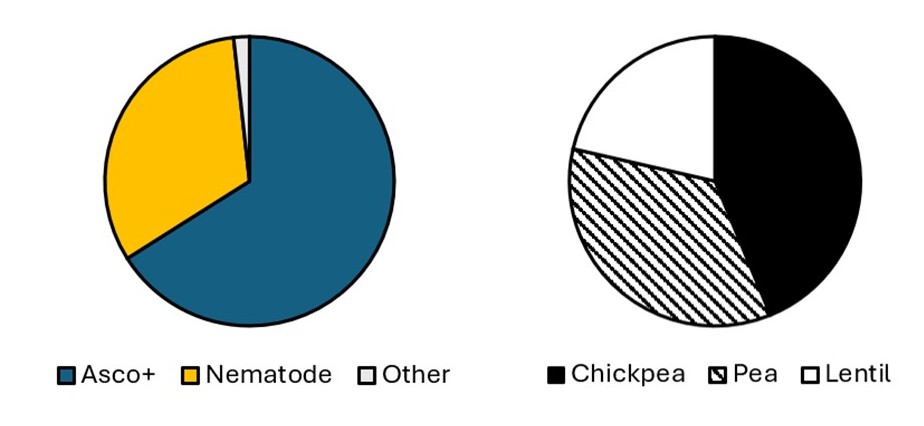 Figure 1. Total number of tests conducted in the RPCDL (left) and ratio of chickpea, pea, and
lentil among the Ascochyta-Plus tests (right).
Figure 1. Total number of tests conducted in the RPCDL (left) and ratio of chickpea, pea, and
lentil among the Ascochyta-Plus tests (right).
- Why is crop year measured from August 1 to July 31?
We measure crop year based on our intention to reflect, to the best of our abilities, the disease pressures that seeds faced the previous year, when they were being grown. We cannot guarantee that every sample that arrived during crop year 2025 was actually in-ground in the summer of 2025 (for example, a grower may send us a chickpea sample that’s been stored in a grain bin for a couple of years). Each year, starting in about August, the RPCDL begins to receive recently harvested samples that were grown that summer (i.e., samples received August 1, 2026, were likely grown in the summer of 2026). This is why crop year is essentially “back-dated” to the year when it was most likely grown.
Disease Summary
- Ascochyta-Plus Test
In crop year 2025, disease incidence (Table 1) and disease severity (Table 2) were as follows:
Table 1. Disease incidence (average % of seed lots where a pathogen was detected) in crop year 2025.
|
|
Ascochyta (%) |
Botrytis (%) |
Colletotrichum (%) |
Sclerotinia (%) |
Stemphylium (%) |
|
Chickpea |
26.6 |
6.1 |
0.0 |
0.9 |
7.0 |
|
Pea |
39.0 |
0.5 |
1.6 |
0.0 |
11.6 |
|
Lentil |
25.9 |
0.9 |
14.3 |
0.0 |
13.4 |
Table 2. Disease severity (average % pathogen infestation in pathogen-positive seed lots) in crop year 2025.
|
|
Ascochyta (%) |
Botrytis (%) |
Colletotrichum (%) |
Sclerotinia (%) |
Stemphylium (%) |
|
Chickpea |
4.10 |
0.70 |
0.00 |
0.30 |
0.30 |
|
Pea |
3.11 |
0.25 |
0.25 |
0.00 |
0.57 |
|
Lentil |
1.21 |
0.25 |
0.60 |
0.00 |
0.43 |
Compared to previous years, Ascochyta Blight incidence and severity were higher than normal for both pea and lentil (Figure 2). In pea, Ascochyta incidence was approximately 42% higher than the previous 5-year average; for lentil Ascochyta was almost 3.8x higher than the previous 5-year average. In chickpea, Ascochyta incidence is typically 15-25% of seed lots, so CY2025 was not unusual with 26.6% disease incidence (Figure 2A).
Ascochyta disease severity was higher than previous years as well (Figure 2B); this is possibly due to late-season rains that created more favorable conditions for late-season disease development or shifts in the Ascochyta population. This is also reflected in the unusually high disease incidence of Stemphylium, a warm-weather pathogen that typically develops late in the season.
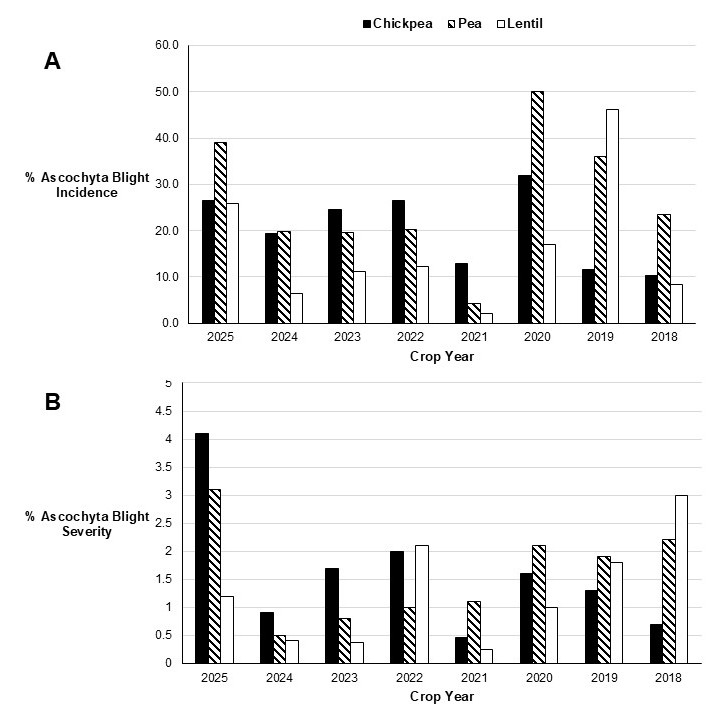
Figure 2. Ascochyta Blight incidence and severity over the years on seed lots (CYs 2018-2025). Ascochyta blight % incidence (seed lots where Ascochyta was detected at any level) over time (A). Ascochyta blight % severity (disease level in seed lots where Ascochyta was detected) over time (B).
Ascochyta Blight is not the only disease observed during testing, see the Appendix for more information on the other diseases.
- Nematode Export Test
Positive nematode export tests are rare, but several seed lots test positive every year. The rate of positive tests is typically around 5% among seed lots tested. In crop year 2025, 5.8% of nematode tests were positive. See the table below for the tests conducted and the detection rates.
Table 3. Nematode export testing in crop year 2025.
|
Crops |
Tests conducted |
Tests with nematode detected |
% of seed lots with nematode detected |
|
Chickpea |
2 |
0 |
0.0 |
|
Pea |
50 |
1 |
2.0 |
|
Lentil |
203 |
25 |
12.3 |
Note that we cannot generate disease severity for this test, as the presence of a restricted nematode, alive or dead, is all that is required to reject a seed lot.
- Other tests
While the nematode export and Ascochyta-Plus tests are the mainstays of the RPCDL, the lab did conduct 14 other tests. The lab conducts virus testing upon request: the RPCDL conducted 6 BSMV (barley stripe mosaic virus) tests and 3 PSbMV (pea seedborne mosaic virus) tests in crop year 2025. BSMV is a barley virus; while not a pulse crop, the RPCDL’s virus testing capacity makes it easy to conduct other virus tests for certified seed growers. None of the virus tests conducted in crop year 2025 were positive.
The lab also conducted 5 bacterial blight tests for Pseudomonas syringae pv pisi, a bacterial pathogen of peas. These tests are typically only necessary if bacterial blight has already been observed in a field during the growing season, as seed contamination with bacterial blight is a serious concern with a typical disease threshold of 0%. None of the seed lots tested this year were positive.
RPCDL Updates
RPCDL is increasing diagnostic test capability this year! Our lab will add seed testing for important seed-transmitted diseases on dry beans! The Dry Bean Fungal Screen will target Anthracnose Blight (Colletotrichum species) and White mold (Sclerotinia species), important diseases that can impact yield, profitability, and exportation of dry beans. For more information, please visit our website: https://plantsciences.montana.edu/pulsecropdiagnosticlab/pathogentest.html. To submit samples, please check this link: https://plantsciences.montana.edu/pulsecropdiagnosticlab/ordering-shipping.html.
If you have any additional suggestions or diagnostic requests, please feel free to reach out to us!
RPCDL team members:
The RPCDL thanks you for trusting us with your seed testing. It’s a pleasure to work with the growers and companies of Montana and other states. The RPCDL is currently under the management of the following people:
- Erin Gunnink Troth, MSc
Laboratory Manager
Department of Plant Sciences & Plant Pathology
Montana State University, Bozeman, MT 59717
Tel: 406-994-7738
Email: pulsediagnostics@montana.edu or erin.troth@montana.edu
- Raissa Debacker Moura, PhD
Director of the Regional Pulse Crop Diagnostic Lab - Assistant Professor - Extension
Plant Pathologist
Department of Plant Sciences & Plant Pathology
Montana State University, Bozeman, MT 59717
Tel: 406-994-7621
Email: raissa.debackermoura@montana.edu
Appendix: Disease data over time
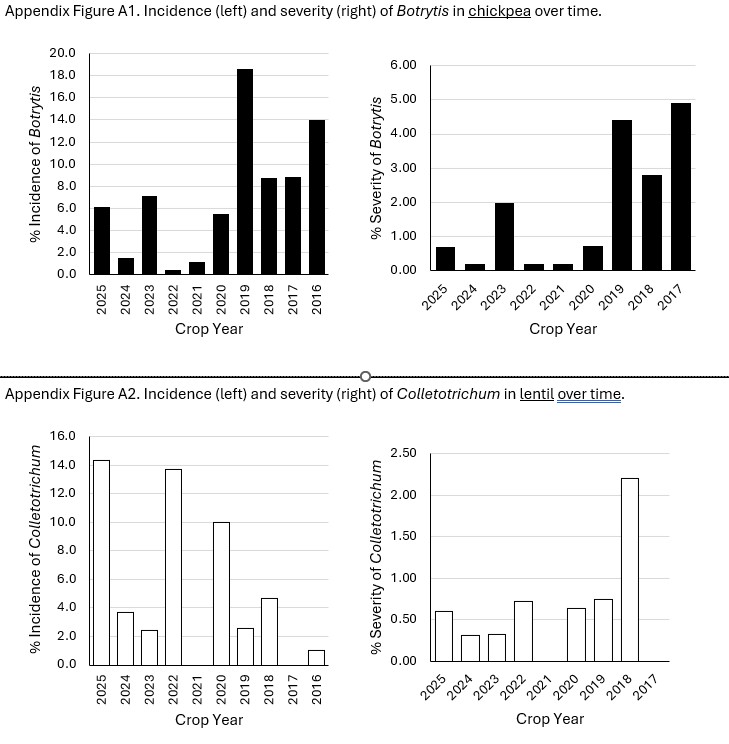
Data of other pathogens over time, such as Botrytis in chickpea (see Figure A1) and Colletotrichum in lentil (see Figure A2). Incidence of Colletotrichum can vary heavily, but severity is typically fairly low. Conversely, both detection and severity of Botrytis in chickpea vary considerably over time.