


Alpine Mushrooms
A Survey of Alpine Agaricales in the Rocky Mountains
Funding
National Science Foundation Grant No. 9971210
June 1999 to 2002
Project Summary
This project will document the diversity of fleshy fungi (Agaricales, Basidiomycota) in the alpine zone of the Rocky Mountains, and is the first extensive survey of arctic-alpine mushrooms in North America (outside Alaska). The agaricales (gilled mushrooms) are a diverse group of fungi, with an estimated 80,000 species worldwide. They are ecologically important in terms of mycorrhizal associations and nutrient recycling. The abundant diversity of arctic-alpine fungi is well-documented for the Alps, Scandinavia, Iceland, Russia, Greenland, and parts of Canada and Alaska . Incredibly, the alpine fungi of the whole Rocky Mountain cordillera remain largely unknown. Over 40 genera of alpine agarics in 12 families, and hundreds of species, are expected in this region. Many will be new taxa. The alpine flora of the Rocky Mountains is a popular topic of study, but a whole Kingdom (Fungi) has been neglected here.
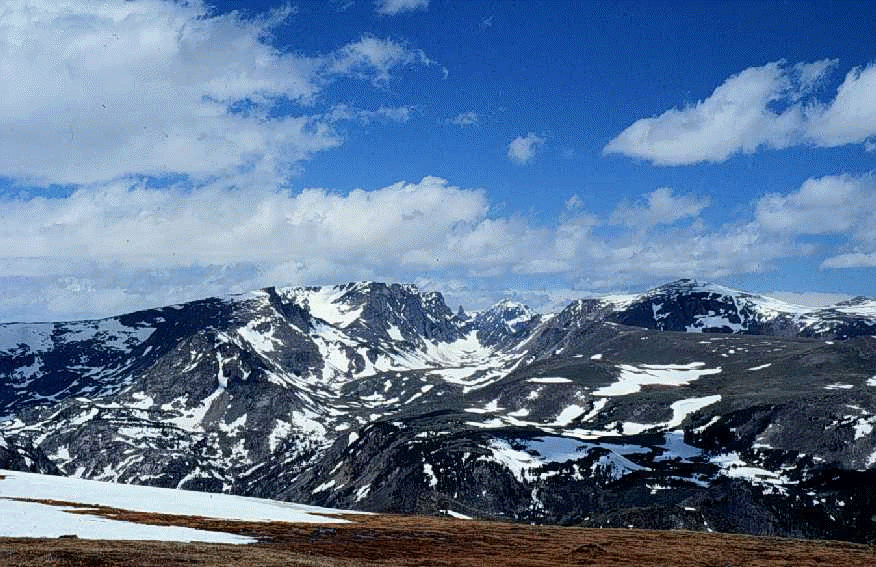
The Rocky Mountain alpine, although fragmented on mountain tops, is an important physiographic region. The largest expanse of tundra in the lower U.S., the Beartooth Plateau, is a floristically diverse alpine region with over 422 species of alpine plants. Further south, along the spectacular heights of the continental divide, the southern floristic province is rich in endemics in areas which escaped glaciation. Preliminary research shows these high windswept areas also support a diverse, unique, and fascinating array of cold-adapted alpine fungi, many not recorded for North America. This project will:
- Generate an authenticated species list by efficient and intensive collection of larger fleshy fungi for 3 years on multiple alpine sites in two floristic zones of the Rocky Mountains,
- Develop an electronic database and interactive keys, linked to color photos and descriptions of fungi of the alpine tundra, and information on their distribution, habitat type, associations,
- Produce (and curate) a new collection of alpine fungi located in official herbaria at Montana State University (MONT) and the Geobotanical Institute in Zurich, Switzerland (ETHZ),
- Train an undergraduate and graduate student, in mycological methods, including field techniques, processing, parataxonomy, data management, curation, and public presentation,
- Disseminate information in journal articles, and at national and international meetings,
- Create an international collaboration between mycologists in Europe and North America.
The tundra biome covers 8% of all land, and the alpine tundra (like the arctic) deserves to be a high priority of study. Both are being examined for sensitivity to global climate change related to increases in temperature, CO2, and UV radiation. Threats to high elevation ecosystems are increasing from mining, recreation, air pollution, and grazing. A "window of opportunity" for research exists now while habitats are still pristine, and impacts are not yet severe.
This survey will help close the gap on circumboreal distributions, contribute new species, and provide collections for future evolutionary, ecological, and physiological studies of alpine fungi. Knowledge of mycorrhizal associations can suggest species for high-elevation reclamation. On a broader scale the simplicity of arctic and alpine systems has possibilities for elucidating global evolutionary patterns. Organisms in extreme environments can be indicators of directional climate change. This research will contribute important knowledge on fungi in cold-dominated environments, tundra ecology, and fungal biodiversity.
 |
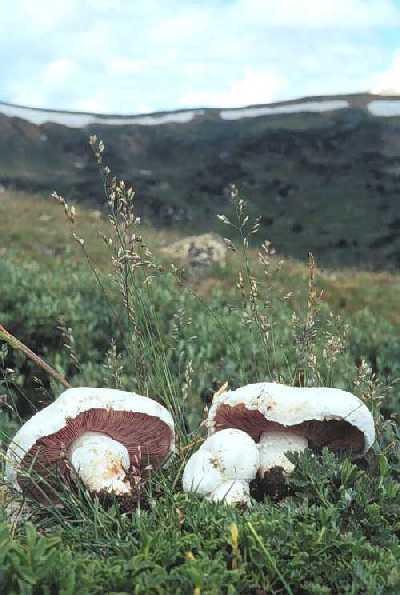 |
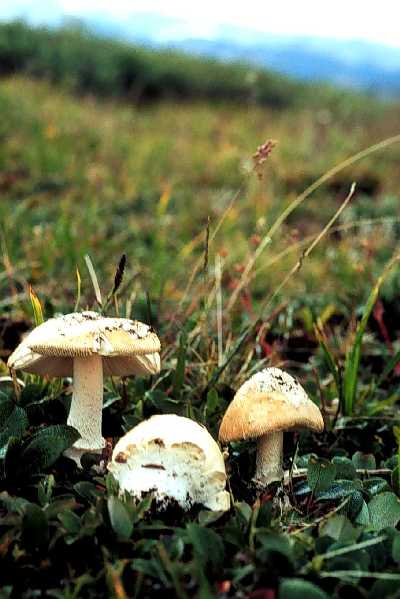
The alpine Amanita's tower above their plant associate dwarf Salix. The saprophytic genus Agaricus is common in open alpine meadows.

Other alpine agarics such as this Omphalina are tiny enough to fit on a penny.